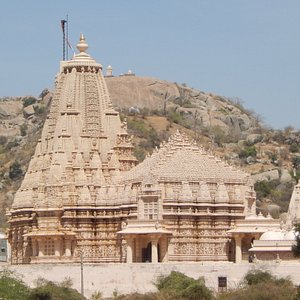
Motu Derasar Palanpur — 108 Shri Pallaviya Parshwanath Jain Tirth Yatra from Ahmedabad
Ask any local in Palanpur for directions to the Pallaviya Parshwanath Jain Temple and chances are they will look at you with mild confusion. Ask them for Motu Derasar — the Big Temple — and every face will light up with instant recognition. That nickname tells you everything about this place. Motu Derasar Palanpur is not just the largest Jain temple in the city. It is the soul of Palanpur's Jain heritage, a structure that has been standing — in one form or another — for over a thousand years, surviving invasions, earthquakes and the full weight of history to remain the most important pilgrimage site in Banaskantha district. The 108 Shri Pallaviya Parshwanath Shwetambar Jain Derasar is one of those rare tirths that carries both extraordinary historical depth and an immediate, living spiritual power that pilgrims feel the moment they walk through its doors.
The presiding deity here is Bhagwan Pallaviya Parshvanath — the 23rd Tirthankara — whose white marble murti stands approximately 45 cm tall in the padmasana posture in the inner sanctum (garbhagriha). The name Pallaviya is not the deity's cosmic name but a name given to this particular miraculous idol by King Prahaladan himself, after the idol cured him of severe illness and transformed him from a Shaivite king to a devoted Jain — a story that is one of the most dramatic conversion narratives in all of Gujarat's Jain pilgrimage history, and one we will tell in detail in the next section.
Besides the main Parshwanath shrine, the temple complex includes additional shrines dedicated to Bhagwan Adinath and Bhagwan Neminath, beautiful idols of Vijay Seth and Vijaya Sethani, the statue of mothers of all 24 Tirthankaras, and carvings that the fortunate visitor from Ahmedabad who has also seen the Dilwara Temples of Mount Abu will find strikingly familiar in quality and character. The temple also holds the last surviving image of King Prahaladan — the founder of Palanpur — making it a site of both religious and historical significance. Palanpur itself is the birthplace of two great Jain spiritual luminaries: Prabhavak Acharya Shri Somsundarsuriji (V.S. 1430) and the celebrated Jagadguru Shri Hirvijaysurishvarji (V.S. 1583), who converted Emperor Akbar to non-violence.
| Temple Name | 108 Shri Pallaviya Parshwanath Shwetambar Jain Derasar (Motu Derasar) |
|---|---|
| Main Deity | Bhagwan Pallaviya Parshvanath — 23rd Tirthankara (45 cm, white marble, padmasana) |
| Founded | V.S. 1011 (c. 954 CE) by King Prahaladan, Parmar dynasty |
| Current Idol Installed | V.S. 1274 by Korantgacchia Acharya Shri Kakkasuriji |
| Jain Sect | Shwetambar |
| Location | Heart of Palanpur city, Banaskantha District, Gujarat |
| Temple Trust | Shri Pallaviya Parshvanath Jain Shwetambar Mandir, Palanpur – 385 001 |
| Nearest Railway Station | Palanpur Junction (~1 km from temple) |
| Ideal Duration | One Day Trip from Ahmedabad |
| Nearby Tirth | Jagana Jain Tirth, Taranga Jain Tirth, Shankheshwar |

One of the important stops in the Jain pilgrimage circuit of North Gujarat
Pallaviya Parshwanath Jain Temple in Palanpur is one of the important stops included in the Jain Tirth Yatra in Gujarat. While most pilgrims from Ahmedabad naturally plan their yatras southward — to Palitana, Girnar, Songadh — there is an equally rich pilgrimage belt to the north, in the Banaskantha and Mehsana districts, that deserves equal attention. Motu Derasar Palanpur is the anchor of this northern circuit. Its antiquity — over a thousand years — its miraculous idol, and its associations with two of the greatest Jain spiritual figures of the medieval period make it a tirth of genuine depth. Palanpur city is also the ancestral home of the legendary Palanpuri Jain diamond merchants, who have dominated the global diamond industry for generations — a community whose prosperity is inseparable from their deep Jain devotion and their connection to this very temple.
Palanpur is also conveniently located on the road to Mount Abu, Rajasthan — the site of the world-famous Dilwara Jain Temples. Many Jain families who plan a Dilwara yatra from Ahmedabad naturally plan a Pallaviya Parshwanath darshan on the same trip. The same route (NH27 via Mehsana) passes through Palanpur, making it a perfect and deeply meaningful stop. Adinath Travels offers this as a combined 2-day package — Palanpur (Motu Derasar) + Dilwara Temples Mount Abu — starting from Sabarmati, Ahmedabad.
How a Shaivite king melted a Jain idol, fell gravely ill, and founded a city as an act of atonement
The origin story of Pallaviya Parshwanath Jain Temple is one of the most vivid narratives in Gujarat's Jain pilgrimage tradition. In V.S. 1001, King Prahaladan of the Parmar dynasty came to the throne of Abu. He was a Shaivite — a devotee of Lord Shiva. One day, he took a massive Panchbhutti (five-metal: gold, silver, copper, zinc, brass) Jain Tirthankara idol from Anchalgad Tirth (present-day Delwara, Mount Abu), melted it down, and cast a Nandi bull statue from the molten metal for the Achaleshwar Mahadev temple. Within days, the king was struck down with a severe illness diagnosed as leprosy — a disease that the best physicians of the time could not cure.
In desperation, King Prahaladan sought the guidance of the great Acharya Shri Sheeldhavalsurishvarji. The Acharya told him that his illness was the consequence of destroying a sacred Jain Tirthankara idol, and that the remedy was to establish a new city in a beautiful location and build a magnificent Jain temple there, installing a Parshwanath idol. He was further instructed to bathe with the sacred abhishek (ritual bathing) water of Bhagwan Parshwanath. The king followed these instructions completely. He built Prahaladanpur — now Palanpur — in V.S. 1011 and constructed the magnificent Prahaladan Vihar, a 52-jinalaya (52-shrine) temple complex. After bathing with the abhishek water, he made a full and miraculous recovery from leprosy. He named the idol "Pallaviya Parshvanath" in gratitude and converted to Jainism, becoming a devoted Jain patron and scholar. His Sanskrit drama Partha Parakrama Vyayog is still remembered by scholars today.
Through the centuries, the Motu Derasar was among the wealthiest temples in the region — and consequently suffered repeated attacks during medieval invasions. Each time, the temple was damaged and rebuilt. The original Pallaviya Parshvanath idol was hidden during Muslim invasions for safekeeping; the current white marble idol was formally installed by Korantgacchia Acharya Shri Kakkasuriji in V.S. 1274 (c. 1217 CE). Then came the 2001 Gujarat earthquake. The entire temple structure collapsed under the force of the quake — and yet, in what every pilgrim and every resident of Palanpur considers a miracle, the garbhagriha (inner sanctum) of the Moolnayak Pallaviya Parshwanath idol stood completely intact, unharmed, amid the surrounding ruins. During the subsequent reconstruction, workers digging the site uncovered 112 Jain statues — an astonishing archaeological discovery. (In 1966, a similar dig had yielded 27 ancient statues.) The temple was rebuilt and stands today as a testament to enduring faith.
What to see and experience inside one of Gujarat's most historically layered Jain temples
The inner sanctum of 108 Pallaviya Parshwanath Jain Derasar houses the 45 cm white marble Bhagwan Pallaviya Parshvanath in the padmasana posture — the idol that gave the temple its name, its city its history, and a king his miraculous cure. The architectural quality of the rebuilt temple — with its carved Rang-mandapa (decorated hall), Sabha-mandapa, and finely worked columns and domes — has been compared by visitors to the legendary Dilwara style of Mount Abu, for the fineness of its stone carving and the devotional intensity of its interior space.
Besides the main Parshwanath garbhagriha, the complex has shrines for Bhagwan Adinath and Bhagwan Neminath. Particularly notable are the unique carvings of Vijay Seth and Vijaya Sethani, the statue of the mothers of all 24 Tirthankaras, and a carved leaf of the Kalpavriksha (the wish-fulfilling celestial tree). Many statues within the complex date to the era of King Samprati, grandson of Emperor Ashoka — one of the great Jain patron-kings of ancient India. The temple also has a rainwater harvesting system built into it — a feature almost never seen in Jain temples, and a detail that reveals the thoughtfulness of its builders.
The discovery of 112 Jain statues during the 2001 reconstruction (and 27 more in 1966) transformed this temple from a well-regarded pilgrimage site into a site of significant archaeological interest. The discovered idols represent Jain iconography spanning many centuries — some possibly pre-dating the current temple structure. Several of these statues are now on display within the complex. Spending time looking at these excavated murtis — so many centuries underground — is a deeply moving experience for any pilgrim who appreciates the history of faith.
One of the most historically unique features of Motu Derasar Palanpur is that it holds the last surviving image of King Prahaladan — the founder of Palanpur — within the temple. For a king who founded a city over a thousand years ago, having any surviving image at all is extraordinary. This portrait is considered one of the rarest historical artefacts in the region and is a must-see for anyone interested in the history of Gujarat's Jain royal heritage.
Complete route guide for your Palanpur Jain yatra by car and by bus from Ahmedabad
~170 KM
Via NH27: Ahmedabad → Mehsana → Unjha → Palanpur
Drive time: 3–3.5 hours one way
~165 KM
Adinath Travels pickup — Sabarmati, Ahmedabad
Drive time: 3–3.5 hours
GSRTC + Private
Buses from Geeta Mandir / Paldi bus stand, Ahmedabad
Journey time: 3.5–4 hours (less flexible)
Palanpur Jn.
On the Jaipur–Ahmedabad mainline. ~1 km from Motu Derasar.
Direct trains from Ahmedabad. ~2.5 hrs express trains.
| From City | Distance | Travel Time |
|---|---|---|
| Ahmedabad | ~170 km | 3–3.5 hrs |
| Sabarmati | ~165 km | 3–3.5 hrs |
| Mehsana | ~80 km | ~1.5 hrs |
| Mount Abu (Dilwara) | ~90 km | ~2 hrs |
| Taranga Jain Tirth | ~65 km | ~1.5 hrs |
| Shankheshwar | ~75 km | ~1.5 hrs |
Everything you need to plan your Palanpur Jain yatra smoothly
Pallaviya Parshwanath Jain Temple timings are generally 6:00 AM to 12:00 PM and 4:00 PM to 8:00 PM. Timings may vary on Mahavir Jayanti, Paryushan, and other major Jain festivals when special programmes and extended darshan are held. For the most current schedule and the Palanpur Jain Dharamshala contact number, reach out to Adinath Travels before your trip — we keep updated tirth trust details for all Gujarat Jain tirths.
The Pallaviya Parshwanath Dharamshala (managed by the temple trust) provides clean and Jain-appropriate lodging for pilgrims who want to stay overnight. A Bhojanshala (Jain dining hall) is also available. The complex additionally maintains Gyanbhandaars (Jain libraries), Upashrayas and Pathshalas — making it a fully self-contained Jain pilgrimage campus. Advance booking for Dharamshala is recommended during October–February and around major festival dates.
The Motu Derasar is located in the heart of Palanpur city — in the older, congested inner-city area. The bylanes near the temple are narrow, so ask your driver to park at a suitable distance and navigate the last 5–10 minutes on foot through the vibrant local marketplace. Ask locals for Motu Derasar — that name is universally recognised. From Palanpur Junction Railway Station, the temple is approximately 1 km — reachable by auto-rickshaw.
Remove all leather items (shoes, belts, wallets) before entering — strict Jain temple norms apply. Wear clean, modest clothing. Carry cash for prasad and donations (ATMs are available in Palanpur town). The temple is compact enough to see fully in 45–60 minutes, but plan 1.5–2 hours if you want to explore all the statues, carvings and the 112 excavated murti display. Since Palanpur is in north Gujarat near the Rajasthan border, winters (November–January) can be quite cold — carry a warm layer.
Season-by-season guide for your Palanpur yatra from Ahmedabad
Ideal for Palanpur yatra. North Gujarat winters are pleasantly cool (8°C–26°C, can get cold in December–January). The drive from Ahmedabad on NH27 is comfortable. This is also when you can combine Palanpur with Taranga, Shankheshwar and a Mount Abu trip comfortably. Book your cab in advance during this popular season.
Temperatures are pleasant and rising. An early departure from Sabarmati at 6:00 AM gets you to Palanpur by 9:00–9:30 AM for morning darshan in comfortable weather. March is excellent for the Palanpur + Mount Abu Dilwara 2-day combination before the summer heat sets in.
North Gujarat gets hot (38–44°C) but the Palanpur temple visit is entirely indoors and relatively quick. Depart early (5:30–6:00 AM) from Ahmedabad, reach by 8:30–9:00 AM, complete darshan before 11:00 AM, and head back. The drive on NH27 is highway-quality and the AC cab makes it comfortable.
Paryushan — the holiest Jain festival — falls in August–September. Visiting Motu Derasar during Paryushan is a particularly moving experience as the temple fills with devotees for special prayers, swadhyay and samayik. Roads are good, the monsoon adds green beauty to the North Gujarat countryside drive, and the darshan atmosphere is uniquely charged with devotion.
Comfortable cab & Tempo Traveller with Sabarmati pickup for your Palanpur Jain pilgrimage
Adinath Travels offers comfortable Palanpur Jain Yatra packages from Ahmedabad with early morning Sabarmati pickup. Our drivers know the NH27 Mehsana–Palanpur route well, and know how to navigate the inner-city lanes near Motu Derasar. Since Palanpur is close to Taranga Jain Tirth (65 km), Shankheshwar (75 km) and the Dilwara Temples Mount Abu (90 km), our most popular combination is the 2-day Palanpur + Dilwara (Mount Abu) Jain Yatra — a premium pilgrimage covering North Gujarat and Rajasthan's greatest Jain tirths. For a quick one-day darshan, Palanpur is perfectly doable in a day from Ahmedabad with time to spare. Call us to plan your yatra.
Up to 4 passengers · Sabarmati to Palanpur
Round Trip from Sabarmati, Ahmedabad
Up to 7 passengers · Family Palanpur Yatra
Round Trip from Sabarmati, Ahmedabad
Up to 12 passengers · Group Yatra
Round Trip from Sabarmati, Ahmedabad
* Prices are indicative. Contact us for a confirmed quote based on your date and group size.
A practical, well-paced day plan for complete Motu Derasar darshan + nearby tirths
Palanpur sits at the gateway to a rich network of Jain pilgrimage sites in North Gujarat and Rajasthan
Jagana Jain Tirth is one of the notable Jain pilgrimage sites near Palanpur in the Banaskantha district. Located approximately 20–25 km from Palanpur town, Jagana has a Jain temple complex that can be comfortably added to the Palanpur yatra on the same day. Most families who drive from Ahmedabad to Pallaviya Parshwanath combine a Jagana Jain Tirth visit in the afternoon after the main Motu Derasar darshan. Adinath Travels can include Jagana in your one-day Palanpur itinerary — just mention it while booking.
Taranga Jain Tirth is approximately 65 km from Palanpur — a major Shwetambar Jain tirth in Mehsana district, home to the beautiful 12th-century temple of Shri Ajitnath Bhagwan built by King Kumarpal of the Solanki dynasty. Taranga's hill-based temple complex is one of the finest examples of medieval Jain architecture in North Gujarat. Many yatri families from Ahmedabad combine Palanpur + Taranga in a single well-planned day, or as part of a 2-day North Gujarat Jain circuit.
The Dilwara Temples of Mount Abu (Rajasthan) are approximately 90 km from Palanpur — a distance that makes a 2-day Palanpur + Dilwara combination one of the most extraordinary Jain pilgrimage packages available from Ahmedabad. The Dilwara temples — built between the 11th and 13th centuries — are universally regarded as among the finest examples of Jain temple architecture in the world. Their white marble interiors, featuring ceiling sculptures of unmatched delicacy, leave every visitor speechless. Palanpur, being on the same NH27 route, makes a perfect Day 1 stop before the Mount Abu ascent on Day 2.
Explore more sacred Gujarat Jain destinations with Adinath Travels
Everything you need before your Pallaviya Parshwanath Jain Temple Palanpur Tour from Ahmedabad
Book your Pallaviya Parshwanath Jain Temple Tour from Sabarmati, Ahmedabad — comfortable vehicles, North Gujarat route specialists, complete pilgrimage planning.
Starting From
₹4,500
One-day round trip from Ahmedabad/Sabarmati